
Moving in or out of a NSW strata building: bonds, by-laws and the coming reform
Limits on when an owners corporation can ask residents for a bond or fee are planned for 2027 and not yet in force, the Government's only example is bonds for access keys and swipe cards, and until then your building's registered by-laws and the current law apply. If you rent, the Tenants' Union says a building move-in or move-out bond can already be unlawful.
Three NSW Government pages describe the strata bond and fee limits Parliament has just passed. Our count across them: none of the three mentions a move-in or move-out deposit.
Fair Trading's Changes to strata laws page lists the item as setting out when owners corporations can request a fee or bond from residents, and requiring that a bond amount must be reasonable. The Guide to strata law changes calls it "Strict limits on fees and bonds charged to owners, for example for items such as access keys." The Minister's release promises "fair limits on when an owners corporation can charge strata residents a bond or fee", and its only example is bonds for access keys or swipe cards that are far above the replacement cost.
So if your building asks for a bond to move in or out of a Burwood apartment this year, the answer sits in its registered by-laws and the law as it stands, not in a new cap. Burwood Removals' advice is simple: get the by-laws and the building's move procedure in writing before you lock in a date.
Can my building charge a bond to move in?
| Source | Who it names | What it says | Example given | Start |
|---|---|---|---|---|
| Fair Trading "Changes to strata laws" (updated 26 Oct 2026) | Residents | "Setting out when owners corporations can request a fee or bond from residents and requiring that a bond amount must be reasonable" | None | Listed under "Changes planned to start in 2027", no date |
| "Guide to strata law changes" (updated 26 Oct 2026) | Owners | "Strict limits on fees and bonds charged to owners" | Access keys | 2027, no date |
| Minister's release, 16 Oct 2026 | Strata residents | "fair limits on when an owners corporation can charge strata residents a bond or fee" | Bonds for access keys or swipe cards "exorbitantly higher than the replacement cost" | No date |
| Move-in or move-out deposits named: none of the three | ||||
The Government pages describe limits on bonds and fees only as one of the Changes planned to start in 2027, and until then the scheme's registered by-laws and the law as it stands apply.
Two details matter when you read the reform. First, no start date is given: the item sits under 2027 with no day or month. Second, the pages do not word it the same way. One says residents, one says owners, and the examples are keys and swipe cards. Whether the limits will reach a deposit for using the lift on moving day is not stated on any of them.
Until a commencement date is published, treat it as coming, and check the current position on the Fair Trading page before you rely on it.
What has the strata reform changed so far?
The Minister's release of 16 October 2026 says the Strata Schemes Legislation Amendment (Miscellaneous Bill) 2025 was "Passed by NSW Parliament last night".
That bill is one tranche of a longer program. Fair Trading lists stages that started on 1 July 2025, 27 October 2025, 1 April 2026, 1 October 2026 and 23 October 2026, the last of them after the bill passed. None of those dated stages is about moving or bonds. The bond and fee item is still ahead.
Do I need to book the lift?
The route your sofa takes through common property
- Common property: lifts, corridors, hallways, foyers, stairwells, car parks (Tenants' Union)
- Your lot: inside your front door
- Building manager controls the use of common property (Tenants' Union)
- Owners corporation must repair common-property carpets and lights (NSW Government)
Usually your building will want to know, because the lift is not yours. Common property includes lifts, corridors, hallways, foyers, stairwells and car parks. Every box you carry from the truck to your door crosses it.
The Tenants' Union says a building manager “control[s] the use of common property”. In practice that means the building's rules decide when the lift can be held, whether its walls need padding and which entry the truck uses. Those rules vary scheme to scheme, so last tower's procedure tells you nothing about this one.
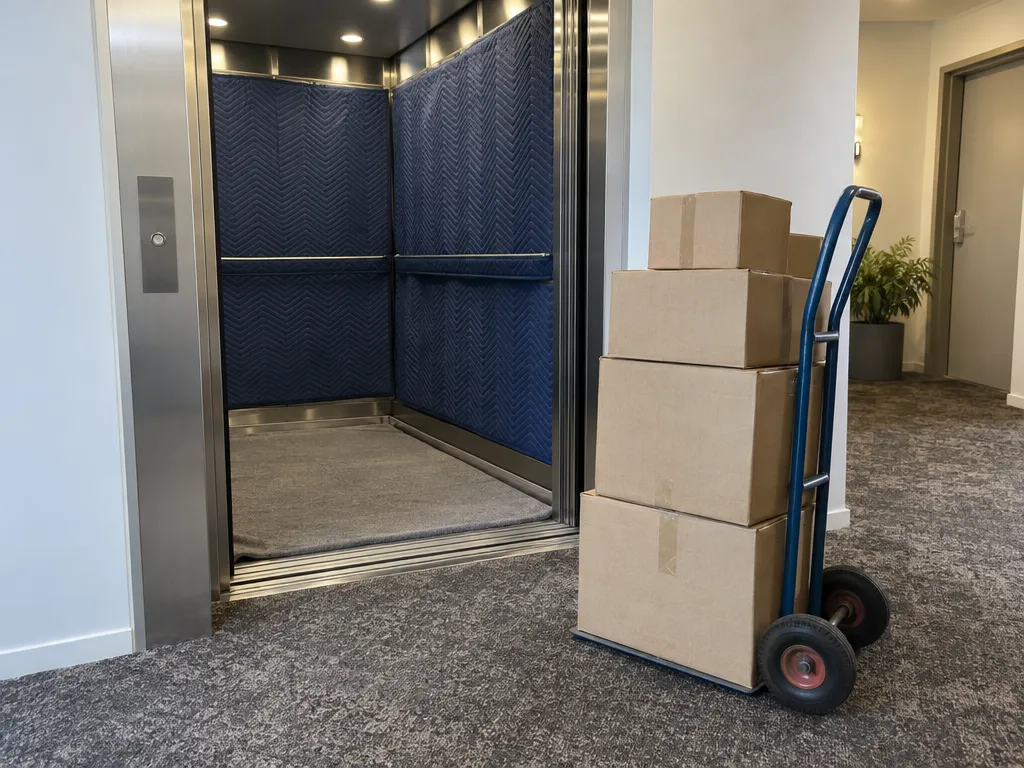
For the practical side, from reserving the lift to timing the loading dock, see our guide to booking a lift and loading dock for a Burwood tower move. If your move lands in the December rush, our Christmas moving dates guide shows the days to plan around.
Which rules count: by-laws or house rules?
- Owners corporation approves a by-law change
- Registered with NSW Land Registry Services (must happen within 6 months of approval)
- Valid and enforceable
Not registered: not valid or enforceable
House rules not registered as by-laws 'are not lawful', says the Tenants' Union
By-laws are rules all residents must follow, and the Government's examples are pets, parking, noise and smoking. A move-in procedure carries weight when it is part of them.
Registration is the test for any change. A by-law change is "not valid or enforceable until they are registered by NSW LRS" (NSW Land Registry Services), and the owners corporation must register a change within six months of approving it.
The Tenants' Union goes further: it says house rules that are not registered as by-laws "are not lawful". That is the Tenants' Union's view. If a building asks you for a bond or a fee, it is fair to ask which registered by-law it relies on.
What if I'm a tenant?
| Question | If you own | If you rent | Source |
|---|---|---|---|
| Where you get the by-laws | Owners corporation, strata manager or agent | Landlord or agent, before you sign the rental contract | NSW Government, Strata by-laws |
| Status of the by-laws | Rules all residents must follow | Legally binding terms of your tenancy (Tenants' Union) | NSW Government, Strata by-laws, Tenants' Union, Strata factsheet |
| Mixed-use building | Management statement sets out shared facilities | Management statement given within 14 days of signing | NSW Government, Strata by-laws |
| Keys and access passes | Should come with the rental keys when the tenancy starts (Tenants' Union) | Tenants' Union, Strata factsheet | |
| Access problem | Tell the building manager in writing (Tenants' Union) | Tenants' Union, Strata factsheet |
You get the by-laws from your landlord or agent, and the Government page says you must be given them before signing the rental contract. Owners get a copy from the owners corporation, strata manager or agent.
Once you sign, the Tenants' Union says by-laws are legally binding terms of your tenancy. Read the moving and common-property parts before move-in day, not after.
If the building has keys or access passes, you "should receive these together with the keys for your rental property when the tenancy starts". If access is a problem, the Tenants' Union says to tell the building manager in writing.
Many Burwood towers sit over shops. In a mixed-use building there is also a management statement that sets out how shared facilities are used by everyone in the building, and tenants must be given it within 14 days of signing. A Building Management Committee uses it to manage shared services "like rubbish collection and deliveries", which can include the route your furniture takes.
A building's move-in or move-out bond, where one is asked for, is a separate thing from the rental bond on your lease, and the Tenants' Union says such bonds can be unlawful, because the Residential Tenancies Act prohibits more than one rental bond. If you are asked for one, get advice from your local Tenants Advice and Advocacy Service, and keep the paperwork for each apart.
What happens if you break a by-law?
- Warning
- Notice to comply
- Mediation (in certain circumstances)
- NCAT (NSW Civil and Administrative Tribunal)
- Tribunal fines, higher for a continuing breach and again if a previous order is not followed
It escalates in steps: warning, notice to comply, mediation in certain circumstances and then NCAT, the NSW Civil and Administrative Tribunal.
At the end of that ladder the Tribunal can fine a resident, with higher maximum fines for a continuing breach and where a previous order is not followed (checked October 2026). A moving day that runs outside permitted hours is a poor way to meet your new strata committee.
Who fixes a damaged hallway, and who covers your goods?
| What | Who is responsible or what applies | Source |
|---|---|---|
| Carpets on common property (such as hallways) | Owners corporation must repair | NSW Government, Repairs and maintenance |
| Lights on common property | Owners corporation must repair | NSW Government, Repairs and maintenance |
| Your furniture and boxes | Removalists are not required by law to insure your property; most only have cover for their vehicle; AFRA-accredited removalists have public liability insurance and can provide transit insurance | NSW Government, Choosing a removalist |
| The removal service itself | Australian Consumer Law guarantee of due care or skill, taking all necessary steps to avoid loss and damage | NSW Government, Choosing a removalist |
The owners corporation must repair common property, including "Carpets on common property (such as hallways)" and "Lights on common property". That is why buildings care who carries a wardrobe down their corridor.
Your own belongings are a different question. Removalists are not required by law to insure your property, and "Most removalist companies only have insurance that covers their vehicle." AFRA-accredited removalists have public liability insurance and can provide transit insurance. Some buildings ask the removalist for a certificate before the crew is allowed in, so ask your strata manager what they need and check what your removalist holds before moving day. Our removalist insurance guide explains public liability against goods in transit.
The service itself comes with Australian Consumer Law guarantees, including "due care or skill, taking all necessary steps to avoid loss and damage". Our guide to what Australian Consumer Law guarantees when you hire a removalist covers your remedies.
What should I ask the strata manager before I book?
Ask in writing, and keep the replies. Rules vary scheme to scheme.
- Can I have a copy of the registered by-laws, and the management statement if it is a mixed-use building?
- What is the move-in or move-out procedure, in writing?
- Which hours can the lift and car park be used for a move, and how do I reserve them? (Our lift and loading dock guide walks through this.)
- Is lift protection required, and who fits it?
- Is a bond or fee asked for, and which registered by-law allows it?
- What evidence of removalist insurance do you need?
- If I'm renting, when do I get the access passes? They should come with your rental keys.
The figures in one place
- Time for tenants to receive a mixed-use management statement after signing14 daysNSW Government, Strata by-laws
- Time for the owners corporation to register a by-law change with NSW LRS6 monthsNSW Government, Strata by-laws
- Limits on strata fees and bondsPlanned for 2027, no start date stated, official example access keys and swipe cardsFair Trading, Changes to strata laws
A few figures and one open date cover most of what a strata move turns on: the Tribunal fines for a by-law breach (checked October 2026), the 14 days a tenant has to receive a mixed-use management statement after signing, the six months an owners corporation has to register a by-law change, and the bond and fee limits planned for 2027 with no start date yet.
Your next step
Get the by-laws and the building's move procedure in writing first. Then send Burwood Removals your two addresses, your preferred date and what each building has told you through our Get a Moving Quote page, so the booking starts from the building's rules rather than a guess.
Sources
- https://www.nsw.gov.au/departments-and-agencies/fair-trading/news/changes-to-strata-laws
- https://www.nsw.gov.au/housing-and-construction/strata/guide-to-strata-law-changes-for-strata-committees-and-owners
- https://www.nsw.gov.au/ministerial-releases/strata-schemes-amendment-reduces-red-tape
- https://www.nsw.gov.au/housing-and-construction/strata/living/by-laws
- https://www.tenants.org.au/factsheet-strata
- https://www.nsw.gov.au/housing-and-construction/strata/living/repairs-and-maintenance
- https://www.nsw.gov.au/legal-and-justice/consumer-rights-and-protection/be-a-smart-consumer/choosing-a-removalist
Pictures in this guide are illustrations, not photos of our jobs.
Book the crew that measures first
Tell us what's moving and where. We call you back, ask the questions that matter, and give you an honest read on crew, truck and hours before anything is booked.